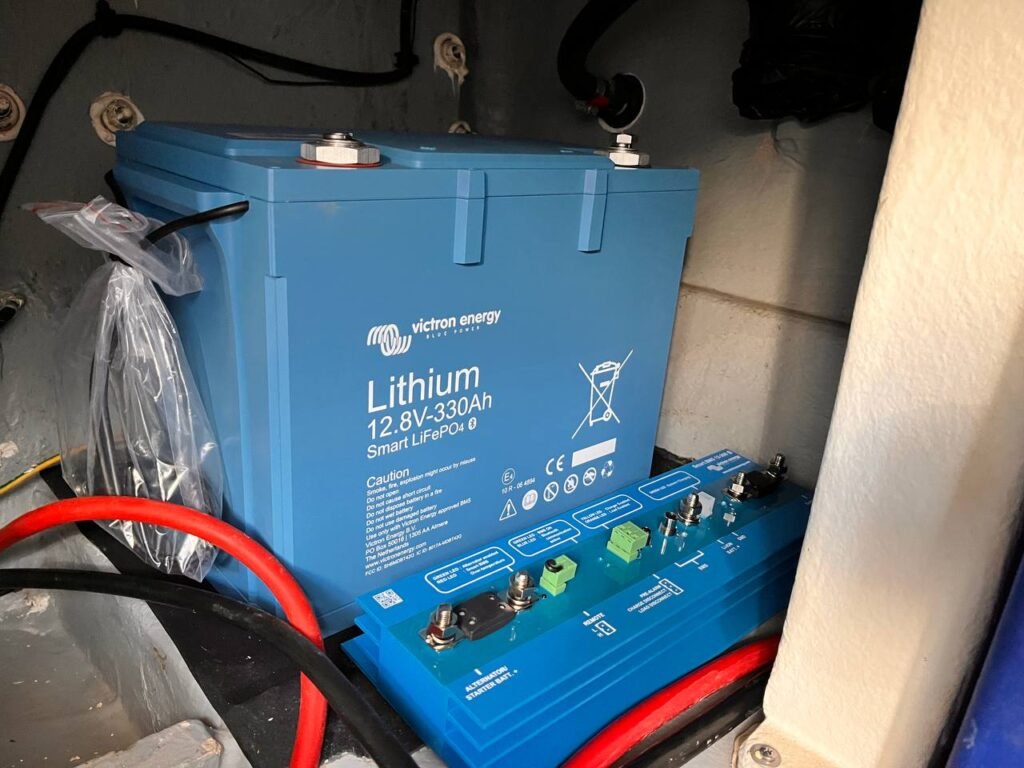
Management and Safety for Victron Lithium NG Marine Battery Systems
Installing Victron Lithium NG 12 V 200 Ah batteries on a vessel requires proper supervision to protect safety, service life and system efficiency. Lithium NG banks require a battery management system (BMS): the batteries do not provide the complete main-disconnect and protection functions needed to prevent overcharge, deep discharge or operation outside safe temperature limits. Without the correct BMS, the installation is exposed to premature failure and, in the worst case, serious risk to the vessel and crew.
The key question is simple: which Victron NG BMS is the right fit for the yacht’s electrical architecture?
Victron BMS Options for Lithium NG Batteries
- SmallBMS NG: Best suited to straightforward systems that do not use VE.Bus inverter/chargers such as MultiPlus or Quattro. It manages the essential battery protections and provides Bluetooth monitoring through VictronConnect. It is a cost-effective option for direct installations and scalable systems up to 50 batteries at 12 V/24 V, or 25 batteries at 48 V.
More from Victron: SmallBMS NG - VE.Bus BMS NG: Designed for installations with VE.Bus inverter/chargers such as MultiPlus or Quattro. It communicates directly over the VE.Bus data network and manages load and charger disconnect/reconnect behaviour according to battery conditions, improving protection and compatibility in advanced marine systems.
- Lynx Smart BMS NG (500 A/1000 A): A robust professional solution integrated into the Lynx Distribution ecosystem, with a main contactor, advanced battery monitor and programmable relay. It can integrate with VE.Can and NMEA 2000 environments and is the strongest choice for yachts requiring high current capacity, modular distribution or future expansion.
More from Victron: Lynx Smart BMS NG
Which BMS Should You Choose?
- With a VE.Bus inverter/charger: the minimum practical choice is the VE.Bus BMS NG. The Lynx Smart BMS NG adds higher-level monitoring, scalability and redundancy, which are valuable in marine installations where continuity of service matters.
- Without VE.Bus: SmallBMS NG covers the essential protections for simpler systems. Choose Lynx Smart BMS NG when the vessel requires professional monitoring, centralised protection, NMEA 2000/VE.Can integration or room for future expansion.
Critical Technical Functions
- Centralised monitoring of battery parameters from the BMS and VictronConnect, with the data presented through one accessible user interface.

- Support for series and parallel banks, enabling systems up to 384 kWh at 24 V, 192 kWh at 12 V and 128 kWh at 48 V.
- Firmware updates through the BMS, simplifying maintenance and improving long-term reliability.
Performance, Safety and Confidence Onboard
Modern marine electronics leave little room for compromise. A correctly specified Lynx Smart BMS NG, VE.Bus BMS NG or SmallBMS NG protects the lithium investment, improves operational safety and gives the captain and engineer clear information about the health of the energy system. In professional yacht installations, integration with recognised industry protocols such as NMEA 2000 can make the difference between a battery bank that simply works and one that is fully maintainable by the crew.
Related Documentation
- SmallBMS NG – Victron Energy
- Lynx Smart BMS NG – Victron Energy
- System Design and BMS Selection Guide – Victron Energy
- Video: Victron NG battery and BMS operation
Plan the Installation Before You Buy
Before selecting a BMS, review the battery voltage, maximum charge and discharge current, inverter/charger architecture, distribution layout, monitoring requirements and any NMEA 2000 or VE.Can integration. A well-designed BMS architecture gives reliable performance and safety every day of the year. Request specialist advice from Area Electronica Naval for a properly engineered lithium system onboard.