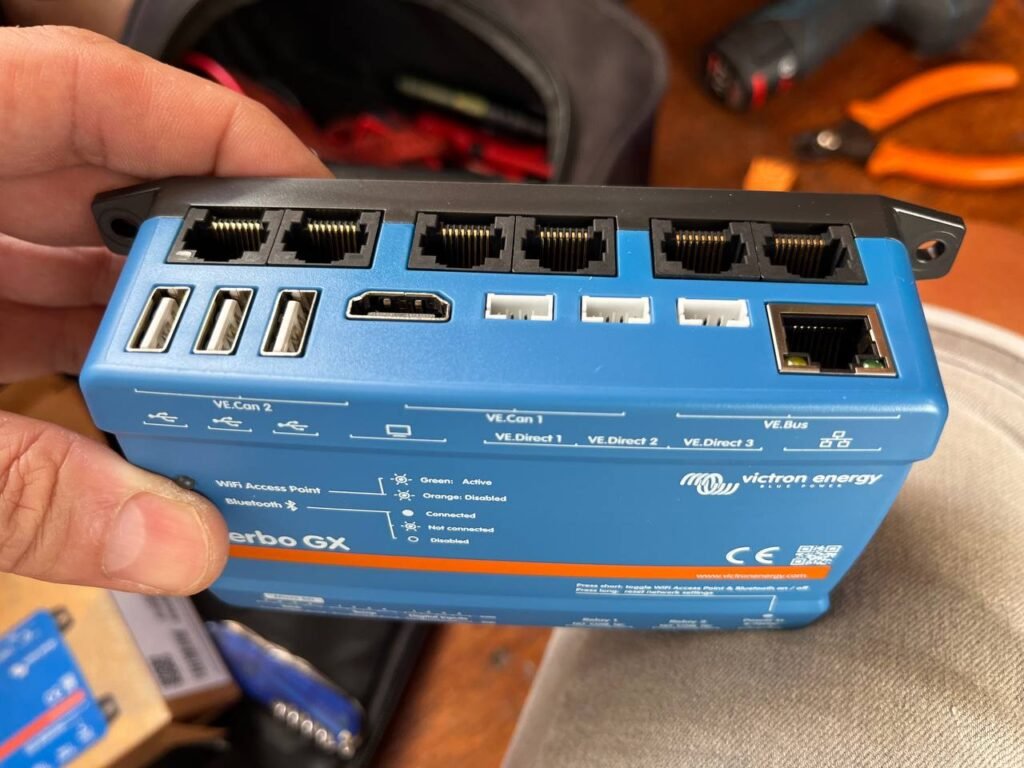

Complete Victron Cerbo GX Integration Guide: Connections, Devices and Sensors for Yachts
If you want reliable onboard and remote monitoring with Victron Cerbo GX or Cerbo GX MK2, this guide summarises the main devices that can be integrated today through VE.Bus, VE.Direct, VE.Can, BMS-Can, NMEA 2000, RV-C, Ethernet/IP, Wi-Fi, 4G, Modbus TCP, MQTT/IoT, USB and Bluetooth. It is written for yacht owners, captains, engineers and technical crew who need a clear view of what works, where it fits, and what to watch for in a marine installation.
Technical detail is preserved: bus types, PGNs, registers, topology limits and commissioning notes are explained in plain English and linked to official documentation where useful.
Section index
- Supported connection types
- VE.Direct: battery monitors, MPPT and more
- VE.Bus: MultiPlus, Quattro and inverters
- VE.Can and BMS-Can: RS products, CAN batteries and tanks
- NMEA 2000 and MFD integration
- RV-C for mixed marine/RV ecosystems
- Ethernet/IP: VRM, PV inverters and energy meters
- Wi-Fi and 4G connectivity
- Modbus TCP for PLC and SCADA systems
- MQTT/IoT, Home Assistant, Node-RED and Signal K
- USB: GPS, RS-485/Modbus RTU and expansion
- Bluetooth sensors: Ruuvi, Mopeka and Safiery
- Best practices for yacht installations
- Frequently asked questions
Quick overview of Cerbo GX connections
- VE.Direct: up to roughly 15 devices when native ports and powered USB hubs are combined. Ideal for BMV, SmartShunt, SmartSolar/BlueSolar MPPT and Phoenix VE.Direct.
- VE.Bus: MultiPlus, MultiPlus-II, Quattro and VE.Bus inverters in single-phase, three-phase or parallel systems, with control, alarms and DVCC.
- VE.Can: MPPT RS, Inverter RS, Multi RS, Lynx products, meters, GX Tank 140 and tank sender adapters. BMS-Can is used for CAN-managed batteries.
- Dual CAN on MK2/Ekrano: separate ports allow VE.Can and BMS-Can to be kept apart, which is strongly recommended on professional yachts.
- Ethernet, Wi-Fi and 4G: local access, VRM remote monitoring and optional cellular failover with GX LTE 4G.
- USB: NMEA 0183 GPS, RS-485 adapters, powered hubs and storage.
- Modbus TCP: LAN-based reading and writing of system data for PLC/SCADA integration.
- MQTT: local or VRM broker, D-Bus to MQTT bridge, Node-RED and Signal K on Venus OS Large.
- Bluetooth: native support for selected environmental and tank sensors.
VE.Direct: battery monitors, MPPT chargers and VE.Direct inverters
Typical devices: BMV-700, BMV-702, BMV-712, SmartShunt, SmartSolar/BlueSolar MPPT, Phoenix VE.Direct and selected Smart IP43 chargers with VE.Direct.
- Wiring: use the native VE.Direct ports on the Cerbo; to expand, use the VE.Direct to USB interface with a powered USB hub.
- Recommended onboard: SmartShunt or BMV for accurate state of charge, and SmartSolar MPPT for complete telemetry and control.
VE.Bus: MultiPlus, Quattro and VE.Bus inverters
Connect MultiPlus, MultiPlus-II, Quattro and VE.Bus inverters to Cerbo GX for control, alarms, DVCC and ESS features. Current limits for shore power and generators can be managed, and generator start/stop can be based on SoC, load, voltage or temperature.
- Best practice: enable DVCC for centralised charge voltage and current control, especially with CAN-managed lithium batteries.
- Remote control: use VRM in full-control mode or local MQTT/Modbus access on the vessel LAN.
VE.Can and BMS-Can: RS products, managed batteries and tanks
Victron VE.Can devices include: Inverter RS, Multi RS, MPPT RS, Lynx Shunt VE.Can, Energy Meter VM-3P75CT, GX Tank 140 and VE.Can Resistive Tank Sender Adapter.
- Tanks:
- VE.Can Resistive Tank Sender Adapter: supports 0-180 ohm EU and 240-30 ohm US senders with multiple tank instances.
- GX Tank 140: 4-20 mA and 0-10 V inputs with sensor supply and USB connection to the Cerbo; useful for diesel, black water and grey water tanks.
- AC measurement: Energy Meter VM-3P75CT via VE.Can or Ethernet for three-phase or split-phase measurements.
- CAN batteries on BMS-Can: integration is available with BYD, Pylontech, Freedom Won, MG Energy, BSLBATT, Dyness, Pytes and others. Always check the official compatibility list and the correct VE.Can to BMS-CAN cable type.
- Hardware layout: on Cerbo GX MK2 and Ekrano GX, keep VE.Can and BMS-Can on separate ports. Do not mix buses.
NMEA 2000 and MFD integration: Raymarine, Navico, Garmin and Furuno
Cerbo GX can publish data to MFDs through Victron apps and supported NMEA 2000 PGNs. It can also read selected NMEA 2000 equipment, such as GPS or compatible DC sensors, through VE.Can with a Micro-C adapter.
- Official MFD guides: Raymarine, Navico, Garmin and Furuno.
- NMEA 2000 GPS: use a dedicated N2K receiver for VRM tracking and geofencing while keeping USB ports free.
- DC alternators: data can be read from compatible N2K regulators; supported examples include Wakespeed WS500, Arco Zeus and Revatek Altion.
- Tip: publish tank levels to the MFD with the correct tank instances, and verify NMEA 2000 power and termination.
RV-C in marine or mixed RV-C/NMEA 2000 environments
Cerbo GX supports RV-C out and selected RV-C devices such as Garnet SeeLevel II 709-RVC tank systems. This is useful on vessels with mixed RV-C and NMEA 2000 architectures.
Ethernet/IP: VRM, PV inverters and energy meters
- VRM (Victron Remote Management): remote monitoring, alarms, firmware updates and control. See the VRM Portal and VRM API.
- PV inverters: integration of supported third-party PV inverters such as Fronius according to Victron’s PV inverter guide.
- Energy meters: VM-3P75CT via Ethernet or VE.Can, plus ET112/ET340 via RS-485.
Wi-Fi and 4G: redundant connectivity
- Wi-Fi/Ethernet: local LAN access plus access-point mode for commissioning.
- GX LTE 4G: Victron’s USB LTE and GPS modem for mobile VRM access; choose the regional variant that matches local bands.
- Advice: prioritise wired Ethernet to the yacht router, use 4G as backup, and adjust VRM logging intervals to reduce data usage offshore.
Modbus TCP: PLC and SCADA read/write integration
Cerbo GX exposes Modbus TCP as a gateway to D-Bus, with Unit IDs per service such as VE.Bus, SolarCharger, Battery, Tank and Meter. It supports reads and writes using function codes 3, 4, 6 and 16; register maps are available in Victron’s official Excel documentation.
- Use cases: power limitation, alarm states to SCADA, external generator start logic and industrial dashboards.
- Best practice: enable only when required, poll only existing registers, respect scaling and document every Unit ID.
MQTT and IoT: local broker, VRM, Node-RED and Signal K
Venus OS can provide a local MQTT broker, an MQTT bridge through VRM and a D-Bus to MQTT gateway for monitoring and control. Venus OS Large adds Node-RED and Signal K directly on the Cerbo.
- Typical flows: custom dashboards, Home Assistant bridge, ESS control, Node-RED automation and publication of marine data through Signal K.
- Writing values: use
dbus-mqttwithW/...topics for setpoints such asAcPowerSetpoint. - Advice: use a local broker for low latency; for fleets, use VRM API or a secure cloud broker with ACLs.
USB: GPS, RS-485/Modbus RTU and expansion
- USB NMEA 0183 GPS: tested models include GlobalSat BU-353S4, BU353-W, ND100 and MR350+BR305US.
- RS-485/Modbus RTU: use the official USB-RS485 interface for sensors such as IMT Si-RS485 irradiance, module temperature, ambient temperature and wind sensors, including Tm-RS485-MB and Ta-ext-RS485-MB variants.
- Powered USB hubs: recommended when combining multiple VE.Direct-to-USB interfaces, GPS and RS-485 adapters.
Bluetooth: compatible sensors without an additional gateway
- Temperature, humidity and pressure: RuuviTag sensors are integrated directly, and multiple sensors can be used per Cerbo.
- Tank level by ultrasound/radar: Mopeka Pro for LPG/water and Safiery STAR-Tank can be configured in Cerbo and published to VRM/MFD.
- BLE range: expect around 5-10 m inside a vessel. Avoid metal bulkheads between sensors and the Cerbo or Bluetooth antenna.


Recommendations for yacht installations
- Bus segregation: choose Cerbo GX MK2 or Ekrano GX when RS products, meters and CAN batteries must coexist.
- NMEA 2000: N2K GPS is usually more robust than USB GPS; check power injection, termination and back-power risks between VE.Can and N2K.
- Bluetooth sensors: Mopeka/Safiery are useful when you do not want to drill tanks; RuuviTag works well in lockers, fridges and machinery spaces.
- Connectivity: connect Cerbo by Ethernet to the marine router and use 4G as failover. Tune VRM logging for passage data limits.
- Automation: Node-RED can handle local logic such as generator start based on SoC plus load; configure MQTT keep-alive and retained values carefully.
- PLC/SCADA: use selective Modbus TCP polling and document Unit IDs for VE.Bus, solar chargers, batteries, tanks and meters.
- Fleet management: use VRM API tokens, asset labels, alarms and geofencing where GPS is available.
Frequently asked questions
Can I mix VE.Can and BMS-Can on the same port?
No. Use hardware with dual CAN, such as Cerbo GX MK2 or Ekrano GX, or separate the networks physically. Managed lithium batteries should be connected to BMS-Can.
Which GPS should I use?
On vessels with NMEA 2000, a dedicated N2K GPS is preferred. If USB is more practical, GlobalSat models such as BU-353S4 or ND100 are commonly used; place the puck with a clear view of the sky.
Is it safe to write values by MQTT or Modbus?
Yes, if permissions, networks and setpoints are controlled. For remote access, use VRM roles or secure tunnels. Onboard, use VLANs/ACLs and strong credentials.
Quick links to official documentation
- Cerbo GX manual: online index
- Supported non-Victron products: complete guide
- Modbus TCP: Modbus TCP manual
- MQTT and Venus OS Large: dbus-mqtt and Venus OS Large
- CAN battery compatibility: list and wiring
- GX LTE 4G: product and manual
- Energy Meter VM-3P75CT: product and manual
Need a specific integration for a yacht or fleet, including PLC logic, NMEA 2000 PGNs, MQTT automations or Node-RED flows? A documented design will make the installation easier to support for years.
Image credits: Victron Energy (Cerbo GX, GX Tank 140 and VM-3P75CT). Images are illustrative and link to manufacturer resources.